
88% of Organizations Face Growing IT Complexity. Here’s How Leaders Are Responding
by Renuka Suresh | Feb 11, 2026
Who Is This For?
CIOs, IT leaders, platform engineering managers, and SRE/DevOps teams running multi-tool monitoring stacks who need faster incident clarity.
The Issue
One production problem can generate 30+ alerts across tools. Teams burn time correlating dashboards before remediation even starts.
Summary
HEAL sits above your monitoring tools, consolidates metrics/logs/traces/events, and turns noise into root cause, early warning, and decision-ready actions.
A Problem You Can Feel Before You Can Measure It
If you’re a CIO or IT leader, you don’t need a report to confirm what your teams are telling you every week: things are getting harder to manage. The stack is deeper. The dependencies are denser. And every new cloud service, microservice, or integration your business adopts adds another thread to an already tangled web.
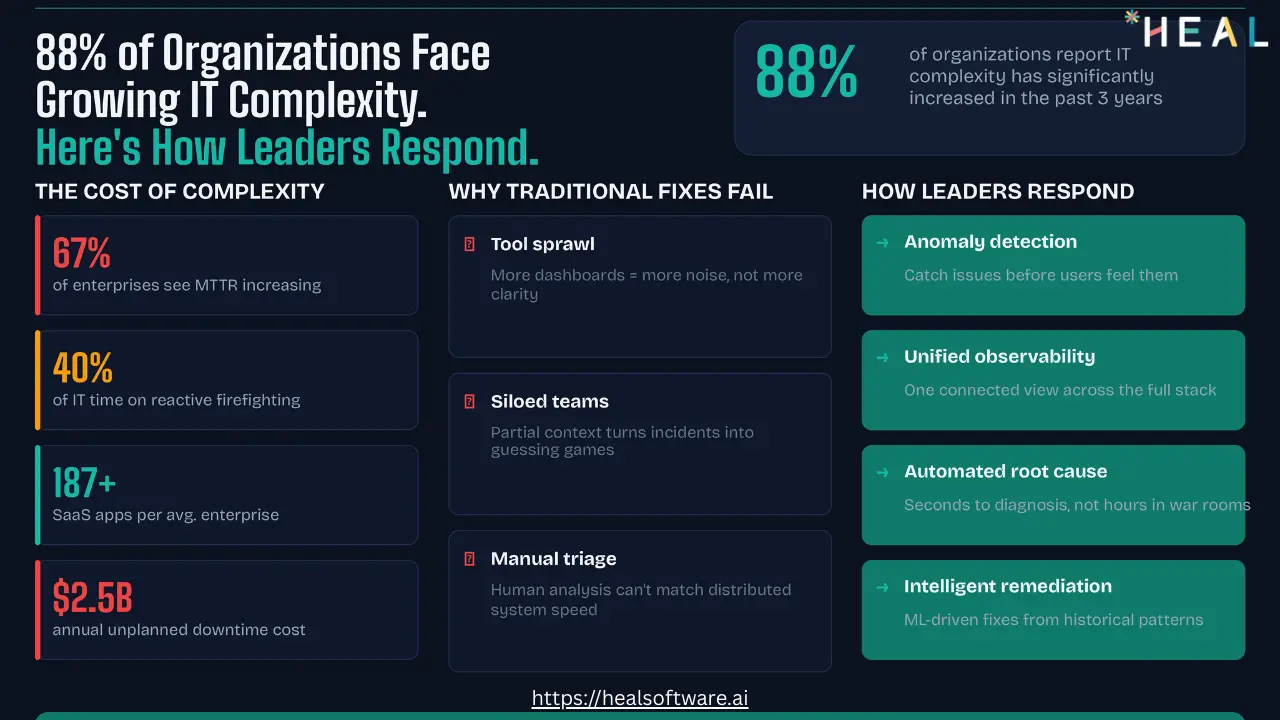
But the data makes the scale of the issue impossible to ignore. Industry research shows that 88% of organizations report a significant increase in IT complexity over the past three years. At the same time, MTTR is climbing at two-thirds of enterprises, IT teams are spending up to 40% of their hours on low-value troubleshooting, and unplanned downtime is costing Fortune 1000 companies an estimated $1.5B–$2.5B per year.
These aren’t isolated pain points. They’re symptoms of the same underlying condition: IT environments have outgrown the tools and processes designed to manage them. And that gap is widening.
The Default Response Is Making It Worse
Faced with this growing strain, most organizations reach for the familiar playbook: add another monitoring tool, stand up another dashboard, hire another engineer. It’s an understandable instinct. But it’s also the reason the average enterprise now juggles 10 to 40 overlapping management tools—each one covering a slice of the environment while none of them can see the whole picture.
The consequences ripple outward. Infrastructure, application, and network teams end up operating in parallel, each with their own data. When a cross-domain incident hits, diagnosing it becomes a coordination exercise across three or four teams, each armed with partial context. What should take minutes, now takes hours. War rooms fill up.
Even the most experienced engineers hit a ceiling here. Human-scale analysis simply can’t correlate thousands of signals across distributed systems fast enough to keep up. The problem isn’t talent or effort—it’s that the operational model was designed for an era when everything ran in one data center and a senior admin could hold the entire topology in their head.
That era is over. And the CIOs who’ve recognized this are approaching the challenge from a fundamentally different direction.
What Leading CIOs Are Doing Differently
The shift isn’t about working harder within the old model. It’s about replacing the model entirely. And the change comes down to one core idea: instead of adding more human effort to match growing complexity, we use intelligent systems to absorb it.
In practice, this plays out across three dimensions.
First, leading organizations are moving from threshold-based alerting—where you learn about a problem only after it’s already hurting users—to AI-driven anomaly detection that flags deviations before they cascade into incidents. It’s the difference between an alarm that goes off when the building is on fire and a sensor that detects the wiring is overheating.
Second, they’re consolidating their fragmented toolsets into platforms that ingest data from across the full stack and correlate it automatically. Rather than asking a human to mentally stitch together signals from a dozen dashboards, the platform builds the connected picture in real time—showing not just what happened, but how one layer affected another.
Third, they’re automating the diagnostic process itself. Instead of assembling a war room and spending hours tracing an issue through logs and runbooks, these organizations use machine learning to identify probable root causes in seconds and recommend the right remediation. The senior engineers who used to spend their days firefighting are now freed up to work on the architecture, automation, and strategy that actually move the business forward.
This approach is AIOps—Artificial Intelligence for IT Operations. And while the label has been around for a few years, what’s changed recently is that the technology has matured enough to deliver on the promise.
AIOps, Demystified
If you’ve been in enterprise IT long enough, you’ve earned a healthy skepticism of buzzwords. To be specific about what AIOps actually does when it’s implemented well, it is an operational layer that sits across your environment.
At its foundation, an AIOps platform continuously ingests operational data—logs, metrics, traces, events, topology maps—from every layer of the IT environment. But ingestion is just the starting point. The real value is in what happens next:
- Noise reduction. Machine learning clusters and deduplicates the thousands of alerts that fire during a single incident, surfacing one actionable event instead of five hundred redundant notifications.
- Pattern recognition. The platform learns what “normal” looks like for your specific environment and identifies deviations early—catching the slow memory leak on Tuesday that would have become Saturday’s outage.
- Contextual diagnosis. When something does go wrong, AIOps correlates events across infrastructure, application, and network layers to isolate the probable cause—what used to be a multi-team, multi-hour investigation into a single finding.
- Automated remediation. Based on historical resolution data, the platform can recommend a specific fix or, where policies allow, execute it autonomously—restarting a hung service, scaling a resource, or rolling back a faulty deployment without waiting for human intervention. This is Self-Healing.
Together, these capabilities don’t just speed up existing workflows. They change the economics of IT operations, allowing teams to manage a more complex environment with fewer fire drills and more strategic bandwidth.
Five Questions for Your Next Leadership Meeting
Before evaluating any platform or vendor, it helps to have an honest baseline of where your organization stands today. These five questions can frame that conversation:
- How many monitoring tools do we maintain, and can any single one show us a cross-stack view of a production incident?
- Has our mean time to resolution improved over the past 12 months—or are we quietly losing ground?
- What percentage of our senior engineers’ time goes to unplanned work versus planned initiatives?
- When we experience a multi-system outage, how long does it take to identify the root cause—and how many people does it require?
- If the business doubles its cloud footprint next year, can our current operating model absorb that without a proportional increase in headcount?
If the honest answers reveal gaps, that’s not a failure—it’s a signal. Nearly every enterprise we talk to is somewhere on this spectrum. The ones pulling ahead are simply the ones who’ve decided to stop managing the gap with heroics and start closing it with a different kind of tooling.
The Complexity Is Permanent. The Struggle Doesn’t Have to Be.
Hybrid and multi-cloud architectures aren’t going to simplify themselves. AI workloads, edge computing, and evolving compliance requirements will only add new layers. The 88% figure from the headline isn’t a temporary spike—it’s the new baseline.
But that doesn’t mean your operations have to feel as complex as your environment. The CIOs who are navigating this well haven’t found a way to eliminate complexity. They’ve built an operational layer intelligent enough to manage it—one that turns raw volume into signal, replaces guesswork with data-driven diagnosis, and scales without requiring you to scale your team at the same rate.
AIOps is how they’re doing it. And the window to treat it as a competitive advantage—rather than a catch-up exercise—is still open.
Ready to see what this looks like in your environment?
Heal Software helps IT leaders turn operational complexity into clarity—without adding to the stack.
About HEAL Software
HEAL Software is a renowned provider of AIOps (Artificial Intelligence for IT Operations) solutions. HEAL Software’s unwavering dedication to leveraging AI and automation empowers IT teams to address IT challenges, enhance incident management, reduce downtime, and ensure seamless IT operations. Through the analysis of extensive data, our solutions provide real-time insights, predictive analytics, and automated remediation, thereby enabling proactive monitoring and solution recommendation. Other features include anomaly detection, capacity forecasting, root cause analysis, and event correlation. With the state-of-the-art AIOps solutions, HEAL Software consistently drives digital transformation and delivers significant value to businesses across diverse industries.