
AIOps Is Consolidating Fast, Here’s Where HEAL Delivers Results
by renuka | Sep 1, 2025
As of September 2025, the Artificial Intelligence for IT Operations (AIOps) market is a rapidly expanding and dynamic sector, projected to surpass $20 billion. The landscape is defined by a major consolidation trend, with large enterprise technology vendors acquiring key AIOps capabilities to integrate into their broader portfolios. Landmark deals like Cisco’s $28 billion acquisition of Splunk, Dell’s acquisition of Moogsoft, and HPE’s purchase of OpsRamp underscore the strategic imperative of AIOps, removing established independent players from the market and reshaping the competitive environment.
Amid this consolidation, a clear hierarchy of market leaders has emerged, dominated by comprehensive, observability-led platforms. Market analysts recognize HEAL Software, Dynatrace, Datadog, BigPanda, and ServiceNow as leaders for their ability to unify cross-domain telemetry and apply AI-driven automation. This dominance pressures niche vendors to either integrate with these ecosystems or specialize in a defensible capability. One such specialty is event correlation, where vendors like HEAL Software demonstrate significant ROI by reducing alert noise by up to 90%.
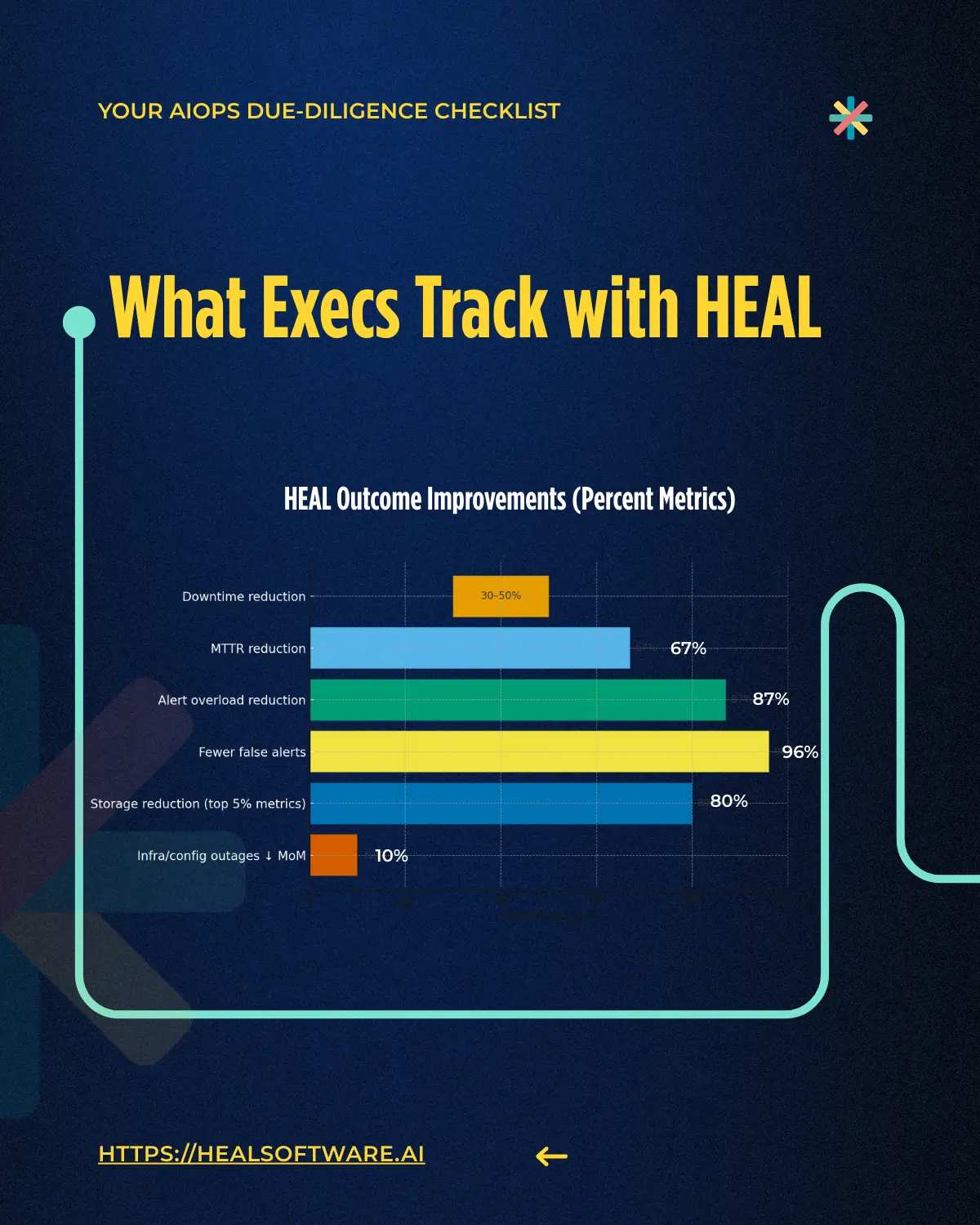
Despite the market’s maturity, significant white-space opportunities persist. HEAL Software Inc., for instance, offers a unique preventive healing platform that now spans event correlation, solution recommendations, automated RCA, capacity forecasting, predictive analysis, early warning, and a GenAI “Talk to Incidents” copilot that helps teams interrogate incidents and accelerate RCA. This highlights a critical market reality: many self-described “AIOps” vendors fail to meet the core criteria of a true AIOps platform—cross-domain data ingestion, topology mapping, correlation, causality determination, and automated remediation. Enterprises must apply this five-point checklist to filter vendor hype and focus on solutions that deliver quantifiable ROI, such as the 30–50% reduction in IT downtime and 15–25% in cost savings reported by successful adopters.
Market Size & Growth Drivers: AIOps Poised for $32.4B by 2028 on 30–50% Downtime Cuts
The AIOps market is experiencing explosive growth, driven by the increasing complexity of IT environments and the clear return on investment from automation.
Market Projections Show a Near Tripling in Size by 2028
The global AIOps market is projected to surpass $20 billion by 2025. Another forecast indicates the market will grow from USD 11.7 billion in 2023 to USD 32.4 billion by 2028, demonstrating a robust and sustained growth trajectory. This expansion is fueled by the fundamental need to automate IT operations, moving from reactive problem-solving to proactive and predictive issue resolution.
North America Holds 48% Market Share, but Global Adoption is Accelerating
As of 2025, North America remains the dominant region in the AIOps market, accounting for approximately 48% of the total market share. This is largely due to the high concentration of large enterprise technology companies and early adopters in the region. However, vendors from EMEA and APAC are successfully closing gaps in the market by catering to specific regional needs and specialized use cases like SAP operations.
ROI Benchmarks: Downtime Reduction and Cost Savings Fuel Adoption
The business case for AIOps is compelling and quantifiable. Organizations that successfully adopt AIOps platforms report significant returns on investment, including:
- An average reduction in IT downtime of 30–50%.
- Savings of 15–25% in overall IT costs.
These outcomes are achieved by using AI and machine learning to correlate cross-domain data, detect anomalies, and determine root causes, thereby preventing service disruptions before they impact the business.
Quick-Scan Vendor Matrix: Verified AIOps Providers
The AIOps market includes a wide array of vendors, from established leaders with broad observability platforms to niche specialists focusing on specific functions like event correlation or network monitoring. The following table provides a snapshot of key players, their market tier, primary focus, and current corporate status.
| Company | Flagship Product/Module | Market Tier | Primary Specialty | Corporate Status |
|---|---|---|---|---|
| HEAL Software | HEAL | Leader | Observability + AIOps + GenAI | Active |
| Dynatrace | Dynatrace Platform (with Davis AI) | Leader | Observability-Led AIOps | Active |
| Datadog | Datadog Platform (with Watchdog) | Leader | Observability-Led AIOps | Active |
| ScienceLogic | ScienceLogic SL1 | Leader | IT Infrastructure Monitoring & AIOps | Active |
| ServiceNow | IT Operations Management (ITOM) | Strong Performer | ITSM & IT Operations | Active |
| BMC | BMC Helix Observability & AIOps | Strong Performer | ITSM & IT Operations | Active |
| Splunk | Splunk IT Service Intelligence (ITSI) | Strong Performer | Observability & Security | Acquired by Cisco |
| OpenText | AI Operations Management | Strong Performer | IT Operations | Active |
| New Relic | New Relic Platform / Applied Intelligence | Contender | Observability-Led AIOps | Acquired by Francisco Partners & TPG |
| Elastic | Elastic Observability / AI Assistant | Contender | Observability & Search | Active |
| PagerDuty | PagerDuty Operations Cloud / AIOps | Contender | Incident Management | Active |
| BigPanda | BigPanda AIOps Platform | Niche | Event Correlation | Active |
| IBM | AIOps Insights / Instana / Turbonomic | Niche | Hybrid Cloud Management | Active |
| LogicMonitor | LM Envision / Edwin AI | Niche | IT Infrastructure Monitoring | Active |
| HPE | HPE OpsRamp | Niche | IT Operations | Active (Acquired OpsRamp) |
| Broadcom Inc. | DX Operational Intelligence | Niche | IT Operations | Active |
| Digitate | ignio AIOps | Niche | Autonomous Operations | Active |
| Moogsoft | Moogsoft AIOps | Niche | Event Correlation | Acquired by Dell |
Competitive Landscape Deep Dive: Leaders Consolidate While Niches Proliferate
The AIOps landscape is characterized by two distinct tiers of vendors: established leaders with comprehensive platforms and strong performers often backed by recent large-scale acquisitions, alongside a vibrant ecosystem of niche players and startups with specialized capabilities.
The Leaders’ Playbook: HEAL Software, Dynatrace, Datadog, and ScienceLogic Dominate with Observability-Led Platforms
Market leaders have solidified their position by offering unified platforms that combine deep observability with powerful, integrated AI engines.
| Company | Platform & AI Engine | Key Differentiator |
|---|---|---|
| HEAL Software | HEAL with Preventive-Healing AI + GenAI | Preventive healing–first AIOps: built-in event correlation, automated RCA, solution recommendations, capacity forecasting, predictive analysis, early warning, and a conversational copilot (“Talk to Incidents”) to interrogate incidents and accelerate RCA end-to-end. |
| Dynatrace | Dynatrace Platform with Davis® AI | A hypermodal AI engine combining predictive, causal, and generative AI for precise, automated root cause analysis without manual configuration. |
| Datadog | Datadog Platform with Watchdog | A built-in intelligence layer that continuously analyzes billions of data points to proactively detect anomalies and surface important signals from noise. |
| ScienceLogic | ScienceLogic SL1 Platform | An AIOps platform providing deep visibility across multi-cloud environments, contextualizing data through relationship mapping, and enabling extensive automation. |
The Niche & Startup Cohort: Specialized Capabilities and Emerging Innovators
Beyond the leaders, a diverse group of niche vendors and startups are driving innovation in specific areas of AIOps. This includes specialists in event correlation, network operations, and emerging paradigms like preventive healing.
| Company | Product | Differentiator | Corporate Status |
|---|---|---|---|
| BigPanda | BigPanda AIOps Platform | Specializes in event correlation to reduce alert noise by up to 95%. | Active |
| HEAL Software | HEAL | Preventive healing platform that also provides event correlation, automated RCA, reduction of false alerts and alert noise, reduction of application and infrastructure outages, and a GenAI “Talk to Incidents” RCA copilot. | Active |
| Selector AI | Network-aware AIOps Platform | AI-powered observability designed to eliminate downtime for large, multi-cloud networks. | Active |
| Digitate | ignio AIOps | An AI-driven platform for delivering autonomous IT operations. | Active |
| Moogsoft | Moogsoft AIOps | An AI-driven observability platform for incident management. | Acquired by Dell |
Functional Segmentation: Why “AIOps” Isn’t One Market
The term “AIOps” is applied to a wide range of tools with different core strengths. Understanding these functional segments is crucial for selecting the right solution.
Observability-Led Suites vs. True AIOps Engines
The market leaders are primarily observability platforms that have integrated AIOps as a core capability. These platforms excel at collecting and analyzing the full spectrum of telemetry data (metrics, logs, traces).
| Company | AIOps Module | Descriptor |
|---|---|---|
| HEAL Software Inc. | HEAL | A preventive healing–first AIOps platform covering event correlation, automated RCA, solution recommendations, capacity forecasting, predictive analysis, early warning, and a GenAI “Talk to Incidents” copilot to converse with incidents and accelerate RCA. |
| Dynatrace | Davis® AI | A hypermodal AI engine combining predictive, causal, and generative AI for precise root cause analysis. |
| Datadog | Watchdog | A built-in intelligence layer that proactively detects anomalies by analyzing billions of data points. |
| Splunk (Cisco) | Splunk IT Service Intelligence (ITSI) | An AIOps solution that predicts future incidents using machine learning and simplifies operations with advanced event analytics. |
| ServiceNow | Predictive AIOps & Cloud Observability | A comprehensive solution using AI to predict and prevent outages and provide unified visibility. |
| IBM (Instana) | IBM Instana Observability | An AI-driven, full-stack observability platform that uses AI and automation to proactively solve issues. |
Event-Correlation Specialists and Alert Noise Warriors
This segment focuses on a core AIOps use case: reducing the overwhelming volume of alerts from disparate monitoring tools and correlating them into a small number of actionable incidents.
| Company | Product Module | Key Capability |
|---|---|---|
| HEAL Software | HEAL AIOps Platform | Integrated preventive-healing AIOps with built-in event correlation, automated RCA, solution recommendations, capacity forecasting, predictive analysis, early warning, and a GenAI “Talk to Incidents” copilot to accelerate RCA. |
| BigPanda | BigPanda AIOps Platform | Reduces IT noise by as much as 95% and correlates events into actionable incidents. |
| PagerDuty | PagerDuty AIOps with Event Intelligence | Leverages data science and ML to diminish system noise and automate event processing. |
| Moogsoft (Dell) | Dell APEX AIOps Incident Management | An AI-driven observability platform offering advanced event correlation and noise reduction. |
| BMC | BMC Helix AIOps | Employs an ML-based event correlation algorithm for event deduplication and reconciliation. |
Boundary Cases & Misclassifications: A 5-Point Test to Separate Hype from Capability
The “AIOps” label is frequently misapplied, leading to market confusion. A true AIOps platform is defined by its ability to automate core IT operations processes using AI/ML, not just present data or automate simple, rule-based tasks.
To qualify as AIOps, a platform must demonstrate five core capabilities:
- Cross-Domain Data Ingestion and Analytics: Ingest and analyze varied IT data (metrics, logs, traces, events) from across the IT landscape.
- Topology Assembly: Automatically discover and map the dynamic relationships between IT assets to create a contextual understanding.
- Correlation and Pattern Recognition: Use ML to group related alerts, suppress noise, and identify meaningful patterns signifying an incident.
- Causality Determination: Pinpoint the most likely root cause of an issue, moving beyond simple correlation.
- Remediation Association or Augmentation: Suggest or automatically execute corrective actions to resolve incidents.
HEAL Software — Preventive Healing Value vs. Market Invisibility
HEAL maps cleanly to all five criteria—cross-domain ingestion and analytics; dynamic topology context used in correlation; ML-driven correlation and patterning; causality determination (automated RCA); and remediation association via solution recommendations (with automation where policies allow).
Technology Deep Dive: Unsupervised AI and Proactive Remediation
HEAL’s core differentiator is its focus on preventive healing. The company’s flagship product, HEAL, is positioned as an AIOps software designed to fix problems before they happen.
Key technological features include:
- Predictive Analysis: Learns normal behavior to surface leading indicators and early warning signals before user impact.
- Event Correlation: Consolidates alerts from disparate monitors into coherent, deduplicated incident narratives that are actionable.
- Automated RCA (Causality): Pinpoints probable root cause leveraging causal signals and service context, minimizing mean time to innocence and restoration.
- Solution Recommendations: Associates incidents with recommended actions or runbooks; can trigger automated remediation where authorized.
- Capacity Forecasting: ML-driven capacity planning for future resource allocation—predicts saturation, flags performance risks, and prevents resource-driven incidents.
- GenAI “Talk to Incidents” Copilot: A conversational assistant that lets SREs ask natural-language questions about incidents (“what changed?”, “blast radius?”, “most likely fix?”) to accelerate triage and RCA.
The Rise of the AIOps Copilot
HEAL’s “Talk to Incidents” explicitly anchors GenAI to RCA acceleration and fix guidance, not just data retrieval—keeping copilots tethered to outcomes, not novelty.
About HEAL Software
HEAL Software is a provider of AIOps (Artificial Intelligence for IT Operations) solutions. HEAL Software’s dedication to leveraging AI and automation empowers IT teams to address IT challenges, enhance incident management, reduce downtime, and ensure seamless IT operations. Through the analysis of extensive data, HEAL solutions provide real-time insights, predictive analytics, and automated remediation, enabling proactive monitoring and solution recommendation. Other capabilities include anomaly detection, capacity forecasting, root cause analysis, and event correlation. With its AIOps solutions, HEAL Software delivers measurable value to businesses across diverse industries.