
Early Warning in AIOps from HEAL Software: The Key to Preventing Downtime
by Raja Shekar Mulpuri | Feb 11, 2025
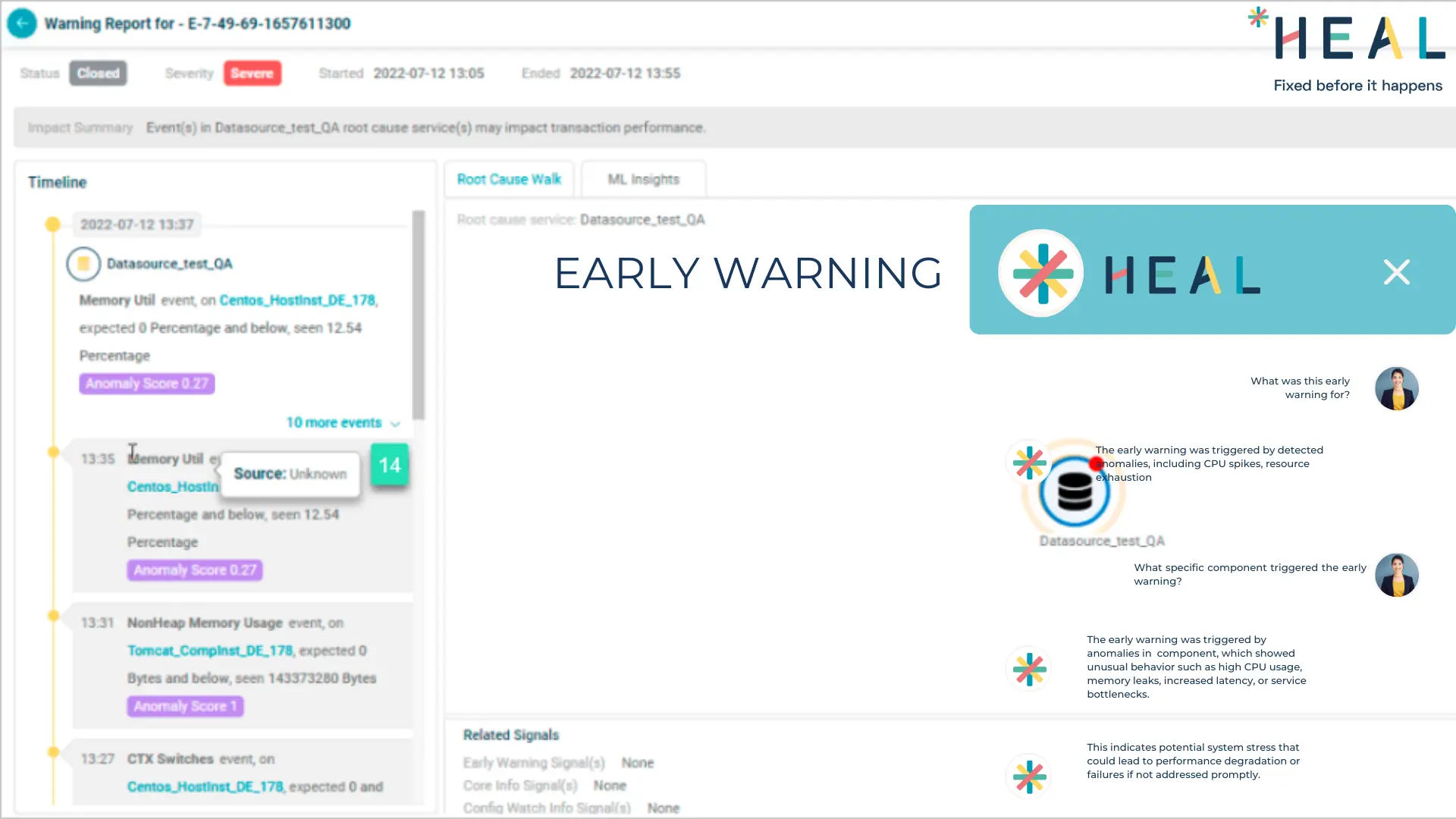
Is HEAL Software’s Early Warning Feature a True Game-Changer for Proactive IT Operations?
The answer is yes.
But, as with any AI solution, the reality is more nuanced.
At HEAL Software, we have spent years perfecting our Early Warning feature by analyzing anonymized data from thousands of global customers and collaborating with IT leaders across industries. AIOps isn’t just a buzzword—it’s a necessity for modern enterprises looking to minimize downtime and enhance operational efficiency.
Q: Why is Early Warning necessary in modern IT infrastructure?
HEAL Bot: As IT environments grow increasingly complex with on-premise data centers, multi-cloud deployments, microservices, and hybrid applications, identifying and resolving potential failures before they escalate becomes more difficult. Traditional monitoring tools detect and alert IT teams after a failure occurs, often when the damage is already done. Early Warning systems shift IT operations from reactive to proactive, using AI-driven analytics to predict and prevent failures before they impact users.
Q: How does automation and human expertise work together in Early Warning systems?
HEAL Bot: AI alone isn’t enough—combining AI predictions with human oversight delivers the best results. Organizations that blend automated alerts with manual validation resolve incidents three times faster than those relying solely on legacy tools. HEAL Software’s Early Warning system achieves 90% alert accuracy, making it a reliable and effective addition to IT operations.
Q: How does Early Warning improve IT team efficiency?
HEAL Bot: Companies using HEAL’s Early Warning feature have seen Mean Time-to-Resolution (MTTR) reduced by 40%. Automated root-cause analysis helps IT teams quickly identify and fix problems.
Q: Can Early Warning help reduce IT costs?
HEAL Bot: Yes. HEAL’s unified monitoring approach eliminates the inefficiencies of siloed IT monitoring tools. By consolidating visibility into a single platform, businesses have reduced troubleshooting costs by 34%, improving efficiency and lowering operational expenses.
Q: What competitive advantage does Early Warning provide?
HEAL Bot: Companies integrating AI-driven alerts into their workflows experience 2.5x faster innovation cycles. With improved visibility and proactive issue resolution, IT teams focus more on strategic initiatives instead of constantly firefighting unexpected issues.
Q: How does Early Warning improve SLA compliance and downtime prevention?
| Metric | Before Early Warning | After Early Warning | Improvement |
|---|---|---|---|
| Critical Incidents | 12/month | 5/month | 58% ↓ |
| Mean Time to Detect | 47 minutes | 12 minutes | 74% ↓ |
| Mean Time to Repair | 2.1 hours | 1.3 hours | 38% ↓ |
| SLA Compliance | 68% | 94% | 38% ↑ |
Q: What makes Early Warning so effective?
HEAL Bot: Its success is driven by three core principles:
- Predictive Analytics – AI analyzes over 10 million historical incidents to flag anomalies.
- Business Impact Scoring – Prioritization based on revenue risk, ensuring critical systems receive attention first.
- Auto-Remediation – 22% of HEAL users automate routine responses like restarting failed containers.
Q: How do businesses use Early Warning to streamline IT operations?
- Anomaly Detection – AI-driven monitoring tracks over 100+ metrics like CPU load, latency, and API failures. A fintech company reduced false positives by 70% after implementing custom thresholds.
- Smart Escalation Paths – Instead of overwhelming IT teams with irrelevant alerts, AI routes alerts to the right teams based on predicted root causes.
- Preemptive Incident Management – AI schedules proactive maintenance to prevent failures before they escalate. During high-traffic periods, banks have prevented millions in potential lost sales through early interventions.
- Automated RCA – Logs, traces, and metrics correlated to detect issues like Kubernetes node failures or misconfigured auto-scaling. A banking firm using HEAL Software resolved 80% of tickets before user impact.
Q: How can businesses maximize the value of Early Warning?
- Enrich alerts with business context – Tag alerts with impact insights (e.g., Affects 10K users) to prioritize resolutions.
- Improve AI models with feedback loops – Training AI with real-world incident data has improved alert accuracy by 48% in just three months.
- Enable cross-team collaboration – Shared dashboards ensure real-time coordination between DevOps, security, and application teams.
- Regularly refine alerting rules – Quarterly reviews align alerts with infrastructure changes and evolving applications.
Q: How can companies develop future-proof IT operations with Early Warning?
HEAL Bot: As AIOps evolves, businesses must focus on AI-human collaboration rather than full automation. AI should handle 24/7 monitoring, while IT teams oversee strategic decision-making. Legacy tools like Nagios and Zabbix still hold value, but integrating their data into HEAL’s predictive analytics platform provides superior anomaly detection and proactive issue resolution.
Q: Can you share a real-world success story of Early Warning in action?
HEAL Bot: Preventing a $2M Payment Gateway Crash
A leading financial services company struggled with payment gateway latency issues, leading to $12M in SLA fines over six months. Their outdated monitoring tools generated 500+ false alerts per day, overwhelming their IT team.
- HEAL analyzed transaction logs and API latency in real time.
- AI dynamically adjusted thresholds based on peak trading hours.
Outcome:
- Detected latency spikes 40 minutes before failure.
- Prevented a $2M outage.
- Reduced SLA penalties by $7M annually.
Q: What is the future of proactive AIOps?
HEAL Bot: Early Warning systems aren’t just about avoiding failures—they’re about preventing them entirely. With predictive analytics and human expertise working together, enterprises can reduce downtime, lower IT costs, improve SLA compliance, and strengthen customer trust.
About HEAL Software
HEAL Software is a renowned provider of AIOps (Artificial Intelligence for IT Operations) solutions. HEAL Software’s unwavering dedication to leveraging AI and automation empowers IT teams to address IT challenges, enhance incident management, reduce downtime, and ensure seamless IT operations. Through the analysis of extensive data, our solutions provide real-time insights, predictive analytics, and automated remediation, thereby enabling proactive monitoring and solution recommendation. Other features include anomaly detection, capacity forecasting, root cause analysis, and event correlation. With the state-of-the-art AIOps solutions, HEAL Software consistently drives digital transformation and delivers significant value to businesses across diverse industries.