
How AIOps Event Correlation Transforms Incident Response
by Renuka Suresh | Jan 29, 2026
Who Is This For?
IT Operations Leaders, Platform Engineering Managers, SRE Team Leads, and DevOps Directors managing complex, multi-tool observability environments who are struggling with alert overload and extended incident resolution times.
The Issue
A single production incident triggers dozens of alerts across siloed monitoring tools within seconds. Engineers waste 12+ minutes manually correlating timestamps, tracing dependencies, and filtering noise before remediation can even begin—extending customer impact and burning out on-call teams.
Summary
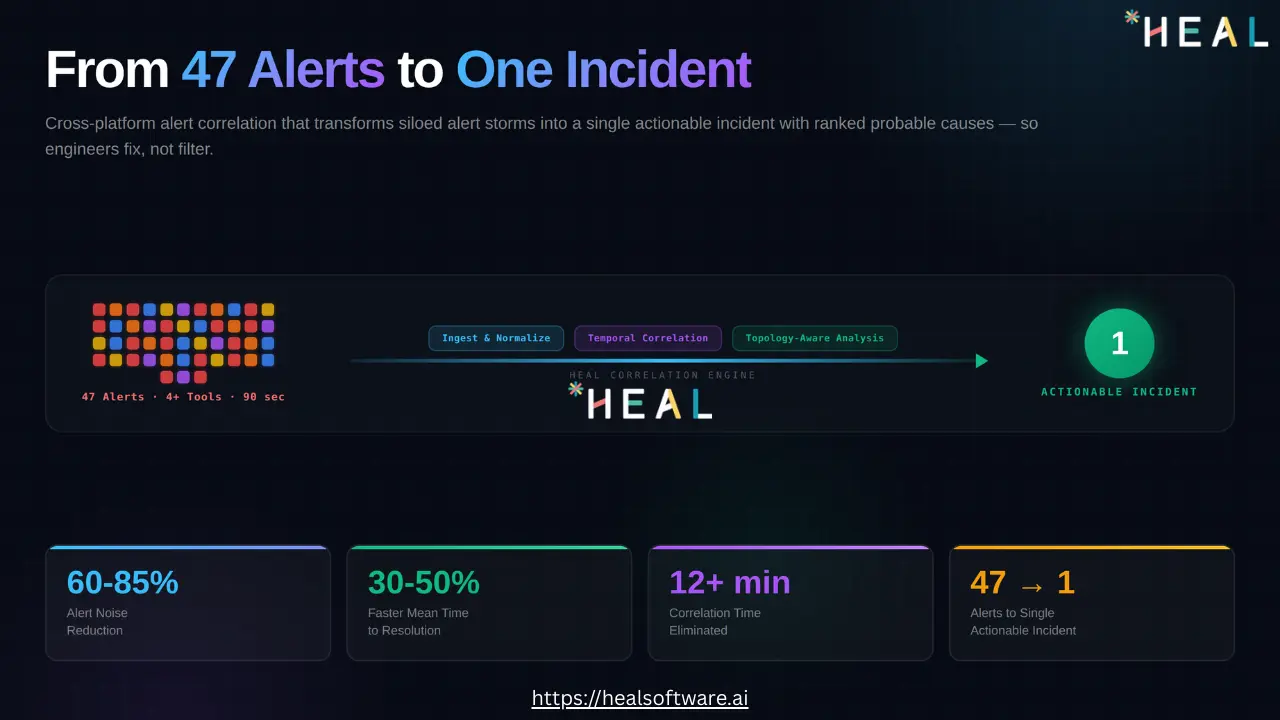
HEAL’s AIOps event correlation ingests alerts from heterogeneous sources, normalizes data, and applies topology-aware analysis to consolidate 47 alerts into one actionable incident with ranked probable causes. Result: 60–85% noise reduction and 30–50% faster mean time to resolution.
The Challenge: Alert Storms Across Siloed Telemetry Sources
A checkout failure in production triggers 47 alerts across infrastructure monitoring, network monitoring, database monitoring and your ITSM tool within 90 seconds. Your on-call engineer receives notifications from three channels simultaneously. Which alert represents the root cause? Which seventeen are symptoms? The engineer spends 12 minutes correlating timestamps, tracing dependencies manually, and ruling out false positives before even starting remediation.
This is the operational reality of modern observability environments. Infrastructure teams rely on tools like Prometheus or Nagios. Application teams instrument with Datadog or New Relic. Security operations maintain separate SIEM platforms. The service desk operates through ITSM tools like ServiceNow. Each system generates alerts based on its own thresholds, formats, and escalation rules—with no native understanding of how these signals relate to each other.
A single root cause—say, a database connection pool exhaustion—triggers cascading failures that manifest as dozens of distinct alerts across multiple tools. Each alert is technically correct: the API is timing out, the queue is backing up, the health checks are failing. But treating each as an independent incident creates cognitive overload precisely when focused attention matters most.
Research indicates that organizations with high alert noise experience 2.3x longer mean time to resolution compared to those with optimized alerting strategies. Every minute spent correlating alerts manually is a minute not spent fixing the actual problem.
What HEAL AIOps Solves
HEAL's correlation engine ingests events from heterogeneous sources, normalizes timestamps and metadata, then applies temporal and topological analysis to correlate related alerts into a single incident with ranked probable causes. The same 47 alerts become one incident tagged with “API gateway timeout” as primary signal and “upstream database saturation” as contributing factor.
Ingestion and Normalization
Different monitoring tools use different timestamp formats, severity scales, and naming conventions. A “critical” alert in one system might map to “P1” in another and “severity: 1” in a third. HEAL's correlation engine addresses this through extensive connector libraries and normalization pipelines. Incoming events are parsed, timestamps are synchronized to a common reference, and metadata is mapped to a canonical schema.
Temporal Correlation
Alerts that fire within a configurable window are candidates for grouping. But pure temporal correlation has limitations—two unrelated issues might coincidentally occur within the same window. Effective temporal correlation incorporates additional signals: alert source, affected resource, and historical co-occurrence patterns. If two alert types have appeared together in 87% of past incidents, their simultaneous appearance carries stronger correlative weight.
Topology-Aware Correlation
Topology awareness is critical. HEAL's platform maintains a service dependency graph—often learned from traffic patterns rather than manually configured—so when an alert fires in the authentication layer, the correlation engine already knows which downstream services will cascade failures. Alerts aren't just grouped by time proximity; they're weighted by dependency relationships and historical co-occurrence patterns.
Machine-learned topology, refreshed continuously from actual communication patterns, provides a more accurate foundation for correlation decisions than manually maintained dependency maps that drift out of sync with reality as architectures evolve.
Measurable Outcomes
Organizations implementing HEAL's event correlation observe measurable improvements across several dimensions:
| Metric | Typical Improvement | Why It Matters |
|---|---|---|
| Alert Noise Reduction | 60–85% | Reduces cognitive load and prevents alert fatigue |
| Mean Time to Resolution | 30–50% faster | Direct reduction in customer impact duration |
| Time to Hypothesis | 12+ minutes → immediate | Engineers start with ranked causes, not raw noise |
| Engineering Capacity | Reclaimed | Time saved on correlation redirected to remediation |
When engineers start diagnosis with a ranked hypothesis rather than raw alert lists, they bypass the correlation exercise entirely. The 12 minutes previously spent connecting dots becomes time spent resolving the issue. Over hundreds of incidents annually, this compounds into substantial operational capacity recovery.
Why It Matters to Your IT Team
You already paid for observability tools. Datadog, Splunk, New Relic, Dynatrace—these platforms represent significant annual spend and deliver genuine value in terms of visibility. But visibility alone doesn't translate to operational efficiency.
AIOps makes that investment operationally useful by turning signals into decisions. Event correlation bridges the gap between having access to data and being able to act on it effectively. It's not about replacing your monitoring tools; it's about making the investment you've already made actually work for you.
Every incident that resolves 20 minutes faster is customer impact you avoided and engineering capacity you reclaimed. That's directly measurable in customer satisfaction scores, SLA compliance, and team capacity for proactive improvement work.
Implementation Considerations
Value realization isn't instantaneous. There's a tuning period during which the correlation engine learns your environment's patterns, builds topology models, and calibrates its grouping algorithms to your specific context.
Initial weeks focus on connector integration—establishing data feeds from your various monitoring sources. The normalization layer requires configuration to map your specific alert taxonomies to the platform's canonical format.
The topology learning phase follows, during which the platform observes service communication patterns and builds dependency models. Organizations with complex microservice architectures may see this phase extend longer, but correlation accuracy improves accordingly.
Expect to iterate on correlation rules during the first 60–90 days. Effective implementations include dedicated time for correlation tuning and establish feedback loops between on-call engineers and the platform configuration.
Key Questions for Vendor Evaluation
- How is topology learned? Manual configuration creates maintenance burden. Automatic discovery from traffic patterns provides more reliable foundations.
- What's the connector ecosystem? Integration depth with your specific monitoring tools determines time-to-value.
- How are correlation rules tuned? Understanding the tuning interface helps predict operational fit.
- What happens to suppressed alerts? Correlated alerts should be accessible for audit while filtered from active noise.
- How is cause ranking determined? The value of correlation depends partly on accurate probable cause identification.
Moving Forward
Event correlation represents the critical link between observability investment and operational efficiency. The gap between having signals and making decisions based on those signals is where incident response slows, engineers burn out, and customer impact accumulates.
HEAL's approach—combining intelligent ingestion, automatic topology discovery, and multi-dimensional correlation analysis—ensures that when an incident occurs, the first thing your team sees is a coherent picture of what's happening, not a flood of undifferentiated noise.
Ready to see event correlation in action?
Request a technical demonstration with your actual alert data to see correlation outcomes specific to your environment.
About HEAL Software
HEAL Software is a renowned provider of AIOps (Artificial Intelligence for IT Operations) solutions. HEAL Software’s unwavering dedication to leveraging AI and automation empowers IT teams to address IT challenges, enhance incident management, reduce downtime, and ensure seamless IT operations. Through the analysis of extensive data, our solutions provide real-time insights, predictive analytics, and automated remediation, thereby enabling proactive monitoring and solution recommendation. Other features include anomaly detection, capacity forecasting, root cause analysis, and event correlation. With the state-of-the-art AIOps solutions, HEAL Software consistently drives digital transformation and delivers significant value to businesses across diverse industries.