
How a Global Banking Leader Tackled Memory Overload with HEAL Software
by Raja Shekar Mulpuri | Jan 30, 2025
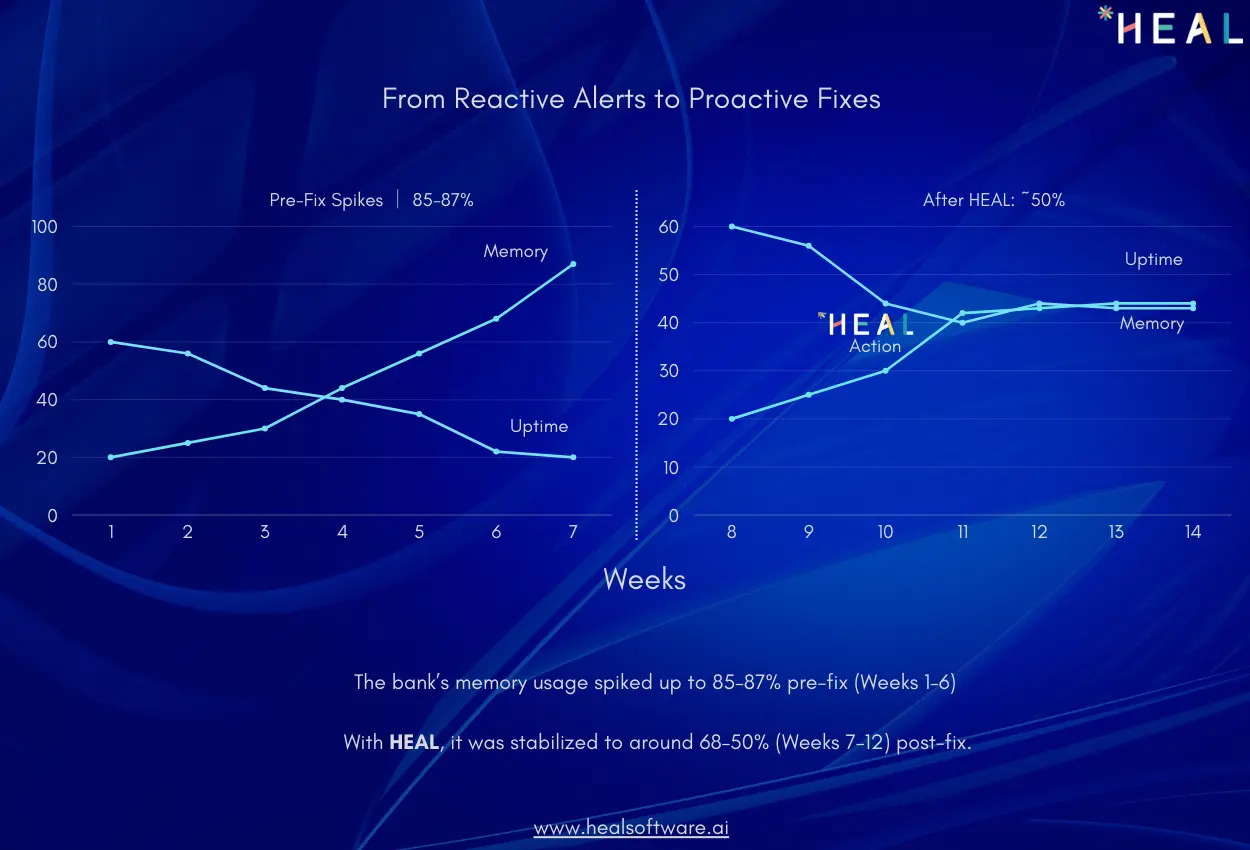
In the financial sector, where system reliability directly impacts customer trust and revenue, even minor IT inefficiencies can spiral into costly crises. For one of the world’s largest banks—supporting 25 million customers, 2,000 branches, and 3,000 ATMs—a hidden challenge threatened its reputation: unpredictable memory consumption in critical applications. Handling over 393 million transactions annually through its Infosys Finacle core banking platform and a hybrid tech stack (Java/J2EE and C++), the bank faced mounting risks as memory utilization soared to critical levels, peaking at 87% during high-traffic periods. This not only slowed transaction processing but also risked system crashes during peak hours.
Unmanaged Memory Spikes Erode Stability
The bank’s IT infrastructure was a tightly woven network of systems:
- Core Banking: Infosys Finacle managed real-time transactions, account updates, and compliance reporting.
- Applications: Java-based front-end services and C++ backend modules handled everything from ATM operations to mobile app requests. The bank’s Java-based applications were running on the Java Virtual Machine (JVM), which manages memory allocation and cleanup for Java programs. However, the JVM’s settings weren’t optimized for the bank’s workload. Specifically:
- Heap Size: The JVM’s memory “closet” (called the heap) was set too large (8GB). This meant the system reserved more memory than it needed, leaving less room for other processes.
- Irrelevant Collection Intervals: The JVM’s cleanup process (irrelevant collection) was running too infrequently (every 2 hours). This allowed unused data to pile up, clogging memory and causing spikes.
- Monitoring Gaps: While existing tools flagged high memory usage, they couldn’t explain why nodes suddenly consumed 85–87% of allocated memory, up from a baseline of 65–70%.
Initially dismissed as “background noise,” these memory spikes grew more severe, occurring 15–20 times per week. Each incident required hours of manual triage by IT teams and vendors, yet root causes remained elusive.
The result?
47 hours of monthly downtime, costing $11.5 million in operational losses and eroding customer confidence.
HEAL Software’s Solution: From Reactive Alerts to Proactive Fixes
HEAL’s AIOps platform deployed a four-stage approach to diagnose and resolve the crisis:
1. Real-Time Anomaly Detection
HEAL’s machine learning models analyzed historical and live data, identifying patterns in memory spikes. Every Thursday at 11 AM—a peak period for corporate payroll processing—memory usage surged by 22% on specific Java nodes.
2. Granular Root-Cause Analysis
By cross-referencing logs, metrics, and application traces, HEAL discovered misconfigured data collection settings in the JVM (Java Virtual Machine). These settings were causing memory leaks, forcing nodes to retain unnecessary data and driving utilization from 70% to 90%+ within minutes.
3. Precision Optimization
HEAL recommended adjusting JVM parameters, including heap size and data collection intervals:
- Heap Size: HEAL recommended reducing the JVM’s heap size from 8GB to 6GB.
- Tuning Data Collection Intervals: HEAL suggested running irrelevant data collection every 30 minutes instead of every 2 hours.
More frequent cleanups prevented memory clutter from building up. This ensured that unused data was cleared out regularly, keeping memory usage stable even during high-traffic periods.
After implementation:
- Memory utilization dropped to 68–72% during peak loads.
- Spikes exceeding 85% were eliminated entirely.
4. Continuous Learning
The platform monitored post-fix performance, flagging similar risks in other nodes. For instance, outdated caching logic in a C++ ATM module was preemptively optimized, preventing a 15% memory creep.
Measurable Gains in Stability and Cost Efficiency
Within three months, HEAL’s impact was undeniable:
- 68% Reduction in Memory-Related Incidents: From 20 weekly alerts to fewer than 8.
- 10% Month-on-Month Downtime Decline: Cutting outages from 47 hours to 38 hours monthly.
- $8.1 Million in Annual Savings: By reducing downtime and manual troubleshooting.
- Stabilized Performance: Memory utilization now stays within 55–65%—even during peak transaction volumes.
Why HEAL Outperforms Traditional Tools
This case highlights three key advantages of AI-driven IT management:
- Contextual Insights: HEAL didn’t just flag “high memory usage”—it linked spikes to specific workflows, like payroll processing, and flawed configurations.
- Actionable Fixes: Instead of vague alerts, teams received step-by-step guidance, such as adjusting JVM heap size from 8GB to 6GB to prevent overcommitment.
- Scalable Prevention: Automated learning ensures similar issues (e.g., C++ caching flaws) are flagged before they escalate.
Small Fixes, Massive Impact
For global banks, HEAL proves that resolving IT inefficiencies isn’t just about avoiding crashes—it’s about unlocking operational potential. By addressing a single JVM misconfiguration, the bank safeguarded millions in revenue, improved customer experience, and freed IT teams to focus on strategic initiatives. In an industry where margins hinge on precision, HEAL’s blend of AI and actionable insights offers a blueprint for turning IT risks into competitive advantages.
Final note: For institutions managing huge transaction volumes, even a 5% memory optimization can translate to hours of uptime and millions saved. HEAL didn’t just fix a problem—it future-proofed a system serving 25 million users.
About HEAL Software
HEAL Software is a renowned provider of AIOps (Artificial Intelligence for IT Operations) solutions. HEAL Software’s unwavering dedication to leveraging AI and automation empowers IT teams to address IT challenges, enhance incident management, reduce downtime, and ensure seamless IT operations. Through the analysis of extensive data, our solutions provide real-time insights, predictive analytics, and automated remediation, thereby enabling proactive monitoring and solution recommendation. Other features include anomaly detection, capacity forecasting, root cause analysis, and event correlation. With the state-of-the-art AIOps solutions, HEAL Software consistently drives digital transformation and delivers significant value to businesses across diverse industries.